
Small Steps Create Big Shifts
The BOSU Lie: Why Wobbling Doesn't Train What You Think It Does
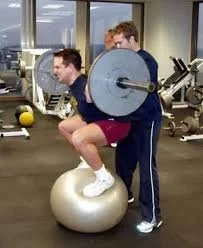
Bosu balancing act
Walk into any gym and you'll see it. Someone balanced on a BOSU ball, arms out like a nervous tightrope walker, face set with grim concentration. Ask them what they're doing and you'll get the same answer every time: training my proprioception.
The logic feels airtight. Proprioception is your sense of where your body is in space. Wobbly things challenge your balance. Therefore wobbly things must train proprioception.
Here's the fun part. That last step is wrong and the reason it's wrong is one of the most genuinely surprising ideas in movement science.
You're winning a fight you didn't know you were in
Standing still isn't passive. Gravity is quietly trying to tip you over every second of the day, and staying upright is an active negotiation your nervous system is running in the background right now, while you read this.
It pulls from three sources of information: your proprioceptive system (sensors in muscles, tendons, joints and skin reporting joint angles and pressure), your eyes, and your inner ear (sensing where your head sits relative to gravity). On firm ground, eyes open, your body leans heavily on proprioception by some estimates around 70% of the signal.
But those proportions aren't fixed. And that's where it gets interesting.
Your brain is a ruthless editor
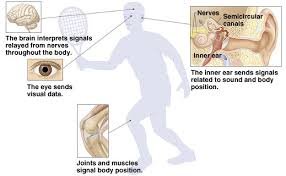
Neural elements to training
Your nervous system constantly asks one question of each sense: can I trust you right now? When one channel goes noisy or unreliable, the brain turns its volume down and turns the others up. Scientists call this sensory reweighting, and it isn't controversial, it's well-documented and robust.
You've felt it. Close your eyes standing up and you wobble a little more, then settle as your brain leans on the other two senses. Stand on a soft cushion and the ground stops being a trustworthy reference, so your brain quietly turns down the input from your ankle and turns up your eyes and inner ear.
Read that twice, because it's the whole twist. Stand on something wobbly and your brain trusts your ankle proprioception less, not more.
So what is the BOSU actually doing to you?
A study by Kiers and colleagues put 100 healthy adults on solid ground and on foam, then gently vibrated specific muscles, a clever trick that reveals how much the brain is "listening" to a given input. On foam, vibrating the calf barely moved the needle. Vibrating the lower back moved it more. Translation: on an unstable surface, the brain stops listening to the ankle and starts listening to the trunk and hips.
Their paper carries one of the bluntest titles in the field: "Ankle proprioception is not targeted by exercises on an unstable surface."
There's a neat logical trap hiding in here too. Two ideas float around gyms: "close your eyes to train proprioception" and "use a BOSU to train proprioception." But closing your eyes makes your body rely more on the ankle. A BOSU makes it rely less. They push in opposite directions, they cannot both be doing the same job. Yet plenty of programmes cheerfully use both in the same session and never notice the contradiction.
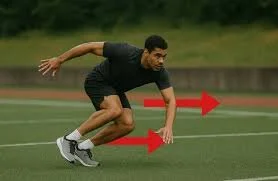
Ankle propreioception
There's also a speed problem. Conscious balance corrections are useful for slow, deliberate movement. But an ankle sprain happens in roughly 0.05 seconds faster than your nervous system can sense the error and fire a correction. By the time the signal arrives, the joint's already past its limit. A 30-second one-legged hold simply doesn't transfer to the chaos of landing, cutting and reacting at real speed.
Now the part that stops this being just another debunk
If the story ended there, it'd be a takedown, and takedowns are boring. So here's what actually matters.
Balance training works. It genuinely reduces injuries. Neuromuscular programmes that include balance work are linked to roughly a 35–50% drop in ankle sprains, and balance components in injury-prevention programmes are tied to substantially lower ACL injury risk. That data is solid.
So both things are true at once: the BOSU doesn't train your ankle's proprioception and balance training reduces injuries. How?
Simple, the exercise works, just not for the reason on the label. Balance and unstable-surface work almost certainly cut injuries through better motor skill, stronger and faster trunk and hip control, quicker reflexes, more muscle co-contraction, and plain old confidence in your own body. Not by sharpening a single sensor in your ankle.
And here's the genuinely lovely bit. The real explanation is more empowering than the myth. "I tuned a passive sensor" is a story about hardware, fixed, limited, a bit out of your hands. "I built skill, strength and control my nervous system now trusts" is a story about you getting better. And skill, unlike hardware, has no ceiling.
There's even a measurement trap worth knowing. When you get better at standing on a wobble board over a few weeks, that mostly means you got better at standing on a wobble board. That's ordinary motor learning. You trained the test, not some deep underlying trait.
The better question
This isn't a reason to throw your BOSU in the bin. It's a tool and like any tool, it does something specific. The mistake was never the equipment. It was the label we slapped on it.

Proprioceptive potential